You are here: home   Blogs   The GOAT Blog   The power and plight of the parasite
The GOAT Blog

The power and plight of the parasite

Document Actions
Tip Jar Donation

Your donation supports independent non-profit journalism from High Country News.

Enter amount:

$
Marian Lyman Kirst | May 29, 2012 11:35 AM

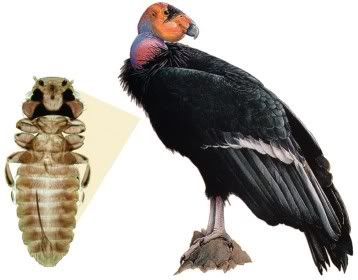
condor headAccording to an April 30th census, the number of California condors—one of the largest and most endangered birds in the world—has reached 405 (both wild and captive). That's the most condors to exist on the planet since recovery of the species began in the 1980’s when only 23 remained, reports the Oregonian. Continuing threats to the birds, particularly lead poisoning—to which the condors succumb after ingesting carrion peppered with the shards of exploded lead bullets—prompted the U.S. Fish and Wildlife Service to capture the remaining birds in 1987 and place them in a handful of captive breeding programs around the West (HCN, 03/05/07, “Get the lead out”).

As the April census indicates, the recovery programs have been a great success, pulling the magnificent bald-headed birds--which sport wingspans of nearly 10 feet and which can live for more than 60 years--from the brink of extinction. But in the process, another, somewhat less charismatic creature, has been wiped out: Colpocephalum californici, an avian chewing louse that lived only on the California condor.

“As far as scientists can tell, based on very limited knowledge, C. californici caused its condor hosts no harm. The bird was simply a mobile home, providing shelter and the occasional feather meal,” reports the San Diego Union-Tribune. The louse was one of an estimated 6,300 known “affiliate species”—pollinators, parasites and mutualists (a species that carries on a mutually-beneficial relationship with another species) that are uniquely adapted to the species on which they depend. Because of the intimate relationships affiliate species share with their hosts, they can tell us a great deal about the biology of the hosts themselves, which can prove especially handy when the host species is rare or endangered.

condor louseBut when the Service rounded up the world’s remaining condors in 1987 and sent them to recovery and breeding centers, the birds were treated for parasites and, as SEED Magazine eloquently describes, “the last C. californici vanished from the Earth in a puff of carbaryl-powder fumigation.”

The lice’s disappearance—the result of negligence rather than deliberate extermination—is an example of “coextinction”, a term coined in the early 2000's to refer to species that go extinct because the creatures on which they depend have become very rare or have vanished entirely.  A 2004 study found that, in the last 200 years, at least 100 species of butterflies, beetles and lice have disappeared as a result of coextinction.  Indeed, in a 2005 article in Conservation Biology about modern insect extinctions, zoologist and author Rob Dunn says that, given the number of species recommended for captive breeding programs—which, through fumigation or disinfection, can wipe out parasitic or mutualistic affiliates (like the condor louse)—hundreds of affiliate species could be lost. “The potential magnitude of coextinctions should make them a key focus of conservation biology, yet the process of coextinction has been little studied,” Dunn says.

And while the annihilation of tiny, blood-sucking parasites and itty-bitty invertebrates may seem like a trifle (or even a plus), studies suggest that the extinction of affiliate species such as parasites is a blow, not a boon, to science. Affiliate species like ticks, mites and lice are “great repositories of history, living chronicles of how organisms evolve over time,” says the Union-Tribune. Because parasites reproduce faster, evolve more quickly, are much more abundant, and have more genetic diversity than their imperiled hosts, they can often teach us more about those hosts than can the hosts themselves (which are often too scarce or fragile to study in detail). From SEED:

If researchers know enough about the parasites and how they move from host to host, the parasites’ genes can be used as proxies for the hosts’ or show interaction between populations that did not result in reproduction.

right whaleIndeed, biologists from the University of Utah used “whale lice”, small parasitic crustaceans that feed off flaking whale skin, to suss out the evolutionary history of the endangered right whale. The feline immunodeficiency virus (a pathogen, not a parasite) has helped reveal the movements and demographics of isolated cougar populations in the northern Rocky Mountains.  And scientists studying the Galapagos hawk, an endangered raptor endemic to the eastern Pacific islands that Darwin made famous, looked to the bird’s feather lice to figure out how and when the birds colonized the islands and how each population is related.

The lice’s mitochondrial DNA, for example, is more variable than that of the parasite’s feathered host, a circumstance that allowed scientists to put together the feather lice’s family tree and reveal the relationships of four of the hawk's eight populations -- “the stepping-stone manner in which, over time, the hawks colonized first one island, then another and another, carrying their lice as they went,” reports ScienceDaily. These relationships were previously hard to untangle due to the imperiled hawk's limited genetic variation.

So when California condor populations finally top 450 birds, the number required before the species can officially be considered for downlisting under the ESA, by all means celebrate. But don't forget to raise a glass to the little lice that once lived on the great bird and to all the parasites, pathogens and symbionts threatened by coextinction, the neglected creatures that may just be as worthy of conservation as the hosts themselves.

Marian Lyman Kirst is an editorial fellow for High Country News

Images courtesy  the National Park Service, photobucket user nutmeg66, and flickr user MyFWCResearch.

McNally Bob
McNally Bob Subscriber
May 30, 2012 12:15 PM
Good piece, with a wonderfully unusual perspective. Goes to show the importance of diversity, how the little critter you never think of has bundles of wisdom, information, and knowledge to bestow. Thanks for this.
Ron Heard
Ron Heard Subscriber
May 31, 2012 07:17 PM
Amazing story, and one I would not have learned about unless Ms. Kirst and High Country News existed. Thank you and keep up the great work!

Email Newsletter

The West in your Inbox

Follow Us

Follow us on Facebook! Follow us on Twitter! Follow our RSS feeds!
  1. In the field with a Montana couple hunting wolves | Amid bitter controversy over allowing hunters and ...
  2. How right-wing emigrants conquered North Idaho | Conservative transplants largely from California h...
  3. Seeking balance in Oregon's timber country | Can logging towns and old-growth forests both thri...
  4. Save our gauges | Important USGS stream gauges imperiled by austerit...
  5. Rants from the hill: Trapping the bees | What to do when 50,000 honeybees hive up inside th...
  1. Don't mess with the Forest Service | How a determined and feisty Forest Service held of...
  2. How right-wing emigrants conquered North Idaho | Conservative transplants largely from California h...
  3. How technology detected a huge mine landslide before it happened | Employees at a Kennecott copper mine outside Salt ...
  4. Seeking balance in Oregon's timber country | Can logging towns and old-growth forests both thri...
  5. The Forest Service battles placer mining with an obscure law | A little-known 1955 law gives the Forest Service a...
More from Flora & Fauna
Eat more insects The UN says we need to rear more minibeasts
BLM teams with researchers to protect midget faded rattlesnake Biologists and federal officials hope to direct booming oil, gas and wind development away from the rare reptile in southwest Wyoming and northwest Colorado
It's Endangered Species Day! 40 years on and the ESA continues to have growing pains
All Flora & Fauna

Most recent from the blogs

 
© 2013 High Country News, all rights reserved. | privacy policy | terms of use | powered by Plone | site by Groundwire | design by Ryan Foster

HCN Logo High Country News in your inbox!


Sign up now to receive our weekly email newsletter!

• The best weekly collection of Western environmental news

• An at-a-glance look at our latest news and analysis


This box was designed to only appear once. It uses a "cookie" (a small file stored on your computer) to remember that it has shown the box to you.

If you are seeing this box appear multiple times, then something is not allowing the cookie to be stored properly. Browsers can be set to not allow cookies, and some people choose to disallow cookies for security reasons. If your browser is setup this way, please consider adding "www.hcn.org" as an exception to your no-cookies rule. For information about how to do this, just search the Web for "browser cookie exceptions."

If you're sure this isn't the problem, then it could be related to how your browser has stored information from our site in previous visits. Browsers often "cache" images, text and other website content in order to make them appear faster if you ever go back. Sometimes the browser's cache can be corrupted or become outdated. The simplest fix for this is to try reloading the page. If that doesn't fix the problem, it may be necessary to clear your temporary items from your browser. Again, a web search will provide you with lots of options and instructions.

Either way, we're sorry to hear that this box is getting in the way of your enjoyment of the HCN website. If you continue to have trouble, please contact our Subscriber Services team.