You are here: home   40years   40 Years in the West   Tom Bell, Spaghetti Westerns and HCN

Dig into four decades of news and community

Revisit some gems from High Country News' forty years of reporting on the West and join the discussion — share your memories!

40 Years in the West

Tom Bell, Spaghetti Westerns and HCN

Document Actions
Tip Jar Donation

Your donation supports independent non-profit journalism from High Country News.

Enter amount:

$
Robyn Morrison | Feb 05, 2010 09:05 AM

"Once upon a time" is a better start to a bedtime story than it is to a retrospective of 40 years of High Country News. But have you ever watched the old movie "Once Upon a Time in the West?" It's Italian director Sergio Leone's best spaghetti western, a three hour epic about the struggle over Sweetwater, a spot of land near the mythic town of Flagstone that contains the region’s only water. The railroad is coming and the landowner, a widowed ex-prostitute, is positioned to make a pile of money since steam engines need water. The gun-slinging oldtimers of the Western high desert face losing their way of life as the railroad forges ahead -- bringing newcomers and new towns.

Dirty deals, double crossing and revenge shooting mark the water and land battle. Charles Bronson plays Harmonica, a mysterious man out to put an end to Frank, a hired gun of the railroad played by Henry Fonda. The movie culminates with a showdown between Harmonica, the good guy in the white hat, and Frank, the bad guy in the black hat. It's classic.

The movie was released in 1968, the same year that High Country News founder Tom Bell took over Camping News Weekly, a local paper in Lander, Wyo., dedicated to hunting, fishing and camping.
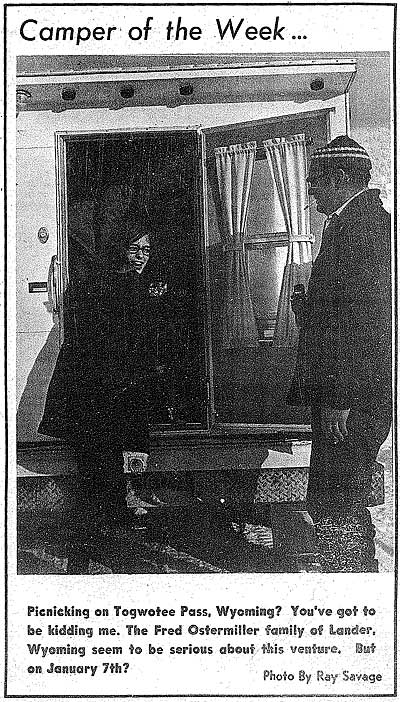
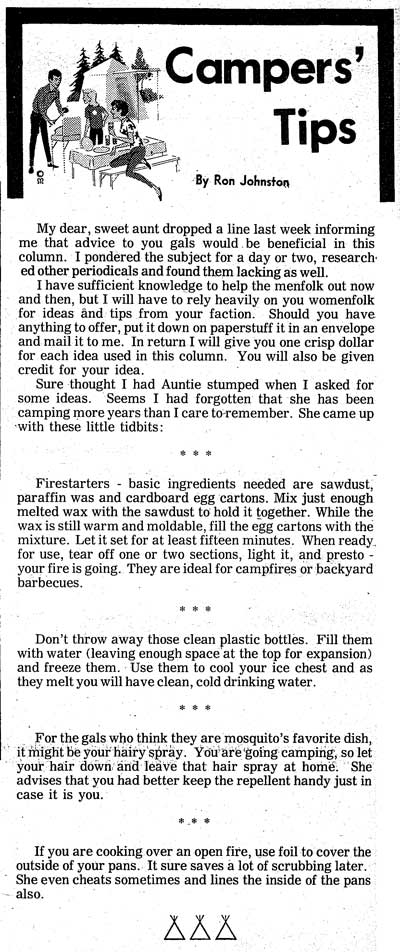
Camping News Weekly carried stories about mountain climbers tackling Teton Peak and questionable ice fishing conditions on Wyoming's Flaming Gorge reservoir. A "Campers' Tips" column advised readers about how to hitch their camp trailer or whether gals should wear hairspray camping. And a weekly front page photo featured the "Camper of the Week."

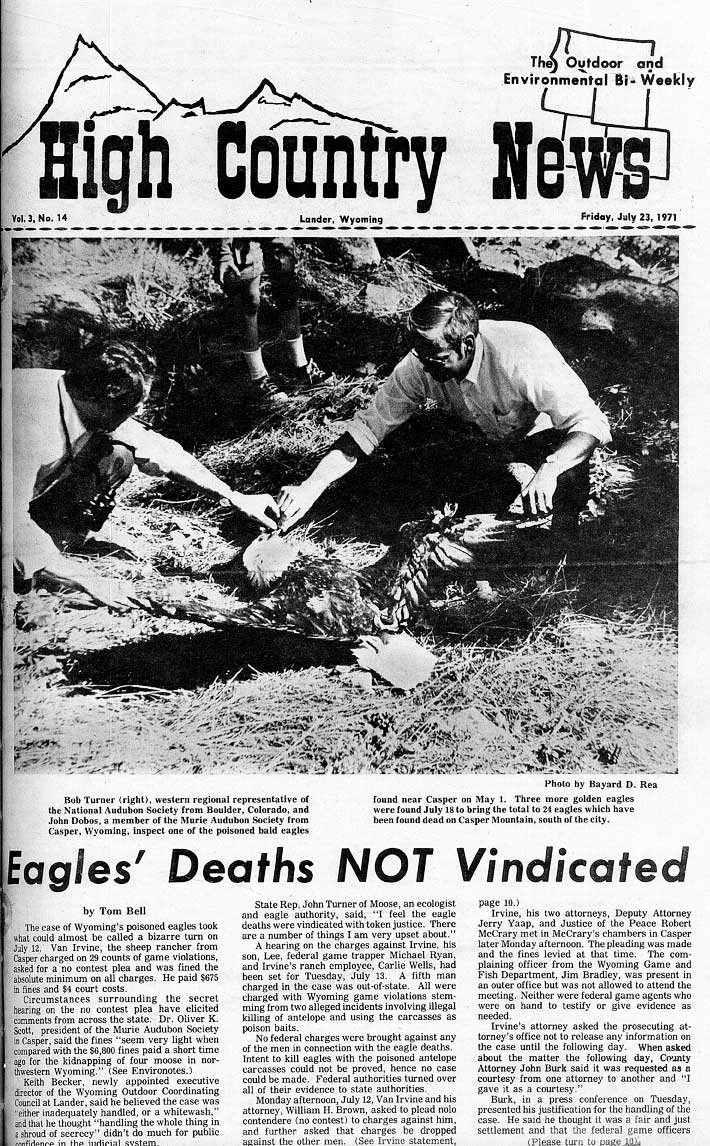
Camping News Weekly didn't include news about Western water wars, land grabs or industry encroachment into the region's remaining wild places. But that changed under Bell as he included more news and opinion about the environmental threats plaguing the West. Within two years, Bell changed the paper's name to High Country News to reflect a "broadened view of the outdoor activities we cover and a growing concern for our environment."

Bell was an unabashed supporter of the budding environmental movement in the West and he chided those who clung to the Old West mentality. "People in the West are still too imbued with what some have termed the 'frontier ethic' or what Oregon Governor Tom McCall has tabbed the 'buffalo-hunter mentality'. We are still too close to the Old West where we ruthlessly exploited the land and all its riches."

But he didn't buy the classic western baloney that neatly divided everything between the bad guys and the good guys, the black hats and the white hats. To be sure, "black hat versus white hat" stories were often found in the pages of High Country News, as environmentalists fought a planned molybdenum mine on the flank of Castle Peak in central Idaho's White Cloud Mountains, or demanded justice when powerful Wyoming ranchers were caught slaughtering hundreds of golden and bald eagles.

Yet Bell had examined the West long enough, as a lifelong Wyomingite, rancher and wildlife biologist, to know the region was a complicated place. He dug into facts and understood the need to make sense of the competing forces at work across the West. "Environmental news is a constantly brewing mix," he wrote in 1972. "It is impossible for one observer to see the whole picture from one perspective. The best that can be done is to look though the eyes of many observers and reporters. And that is what High Country News is trying to do."

It's complexity that High Country News has worked to unravel for 40 years. And a complexity that I'm not so sure plays out in those spaghetti westerns.

The More Things Change . . .
Dave Shishim
Dave Shishim
Feb 05, 2010 01:27 PM
I was reading an old Ed Abbey book "The Journey Home" last night, shortly after reading Ms. Morrison's initial posting and I came across this passage in Abbey's short story, "The Second Rape of the West":

"In the high, cold mountain town of Lander, Wyoming (population 7,500) I stopped for a few hours to visit the people who write, edit and produce the only newspaper in the entire Rocky Mountain West concerned primarily with environmental issues. The High Country News, founded six years ago and published by native Landerian Tom Bell is a biweekly of small circulation but widespread coverage dealing with the whole range of developments that threaten the people of the West:strip mining, power plants, air pollution, water diversion, urbanization, overgrazing, clear cutting, land speculation, and other issues.

In the cubbyhole office of the News, I found Joan Nice, Bruce Hamilton and Marjane Ambler. These young people, none of them looking over thirty, make up the entire editorial staff of the newspaper. They pay themselves a monthly salary of $300 each - enough for rent and beans and shoes.Though many of the feature articles published in the paper come from contributors, the staff writes the bulk of it, sixteen pages every two weeks. They are good people - a new breed of westerner."

Thankfully, the wages at HCN have gone up a bit and there have been other changes for the better as well. But, living just up the road from HCN's offices, I can also say that, thankfully, some things haven't changed. Most notably, the desire, dedication and integrity of today's staff of HCN journalists and support staff remains as strong as that of its founders who so impressed Ed Abbey so many years ago. You continue a proud legacy. Keep up the terrific work, and here's to the next 40 years.
 

HCN Logo High Country News in your inbox!


Sign up now to receive our weekly email newsletter!

• The best weekly collection of Western environmental news

• An at-a-glance look at our latest news and analysis


This box was designed to only appear once. It uses a "cookie" (a small file stored on your computer) to remember that it has shown the box to you.

If you are seeing this box appear multiple times, then something is not allowing the cookie to be stored properly. Browsers can be set to not allow cookies, and some people choose to disallow cookies for security reasons. If your browser is setup this way, please consider adding "www.hcn.org" as an exception to your no-cookies rule. For information about how to do this, just search the Web for "browser cookie exceptions."

If you're sure this isn't the problem, then it could be related to how your browser has stored information from our site in previous visits. Browsers often "cache" images, text and other website content in order to make them appear faster if you ever go back. Sometimes the browser's cache can be corrupted or become outdated. The simplest fix for this is to try reloading the page. If that doesn't fix the problem, it may be necessary to clear your temporary items from your browser. Again, a web search will provide you with lots of options and instructions.

Either way, we're sorry to hear that this box is getting in the way of your enjoyment of the HCN website. If you continue to have trouble, please contact our Subscriber Services team.